Sully by Captain Chesley B. Sullenberger III
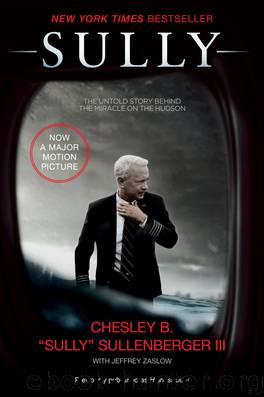
Author:Captain Chesley B. Sullenberger, III
Language: eng
Format: epub
Publisher: HarperCollins
Published: 2016-06-20T16:00:00+00:00
I’VE READ a great deal as I’ve commuted from San Francisco to my base in Charlotte. The trip across the country seems to go faster when I’m engrossed in a book. My tastes haven’t changed much since I was a boy: I continue to be drawn to history.
I have read a few terrific books about the nation’s Medal of Honor recipients. Each of their stories is inspiring. But I remain particularly haunted by the story of twenty-three-year-old Henry Erwin, a U.S. Army Air Forces radio operator from Alabama whose heroism during World War II was astounding. On April 12, 1945, Staff Sergeant Erwin was on a B-29 mission to attack a gasoline plant in Koriyama, Japan. One of his tasks was to help the bombers see their aim points by dropping a phosphorus flare through a tube in the floor of the B-29. The device exploded in the tube, and the phosphorus was ignited, blinding Erwin and engulfing him in flames. Smoke filled the airplane. Erwin knew the flare would soon burn through the floor, igniting the bombs in the bomb bay below, destroying the B-29 and probably killing the crew.
Though Erwin was in excruciating pain, he crawled along the floor, found the burning flare, and held it against his chest with his bare hands. He brought it up to the cockpit, screamed to the copilot to open his window, and heaved it out, saving the other eleven men on board.
Erwin was expected to die within days from his injuries, and the decision was made by General Curtis LeMay to award him the Medal of Honor before he succumbed. The problem was, there was no Medal of Honor to be found in the Western Pacific. The closest one was hours away in a glass display case in Honolulu. And so an airman was dispatched in the middle of the night to go pick it up. When he couldn’t find the key to open the display case, he broke the glass. He collected the medal, and put it on a plane bound for Guam, where it was pinned on the still-alive-and-conscious Staff Sergeant Erwin, wrapped head to toe in bandages.
Erwin surprised everyone, living through forty-three operations. He remained hospitalized until 1947, and after he was released, his burns left him scarred and disfigured for life. Yet he continued to serve his country as a counselor at a Veterans Hospital in Alabama. He died in 2002.
Who among us could have brought ourselves to lift that white-hot flare to our chest with our bare hands? Presented with that situation, I assume I would have let it burn through the floor of the B-29.
Knowing that there have been people like Erwin, capable of doing such extraordinary things—acts that are truly beyond comprehension—I feel that the least I can do is be of service in whatever very small ways are available to me.
Sometimes that means recalling how I felt as a thirteen-year-old, when I first heard the story of Kitty Genovese, and made a vow about the kind of person I hoped to be.
Download
This site does not store any files on its server. We only index and link to content provided by other sites. Please contact the content providers to delete copyright contents if any and email us, we'll remove relevant links or contents immediately.
Whiskies Galore by Ian Buxton(42088)
Introduction to Aircraft Design (Cambridge Aerospace Series) by John P. Fielding(33180)
Small Unmanned Fixed-wing Aircraft Design by Andrew J. Keane Andras Sobester James P. Scanlan & András Sóbester & James P. Scanlan(32836)
Aircraft Design of WWII: A Sketchbook by Lockheed Aircraft Corporation(32336)
Craft Beer for the Homebrewer by Michael Agnew(18289)
Turbulence by E. J. Noyes(8130)
The Complete Stick Figure Physics Tutorials by Allen Sarah(7427)
The Institute by Stephen King(7095)
The Thirst by Nesbo Jo(7012)
Kaplan MCAT General Chemistry Review by Kaplan(6991)
Bad Blood by John Carreyrou(6675)
Modelling of Convective Heat and Mass Transfer in Rotating Flows by Igor V. Shevchuk(6496)
Weapons of Math Destruction by Cathy O'Neil(6371)
Learning SQL by Alan Beaulieu(6349)
Man-made Catastrophes and Risk Information Concealment by Dmitry Chernov & Didier Sornette(6144)
Permanent Record by Edward Snowden(5907)
Digital Minimalism by Cal Newport;(5842)
Life 3.0: Being Human in the Age of Artificial Intelligence by Tegmark Max(5621)
iGen by Jean M. Twenge(5467)
